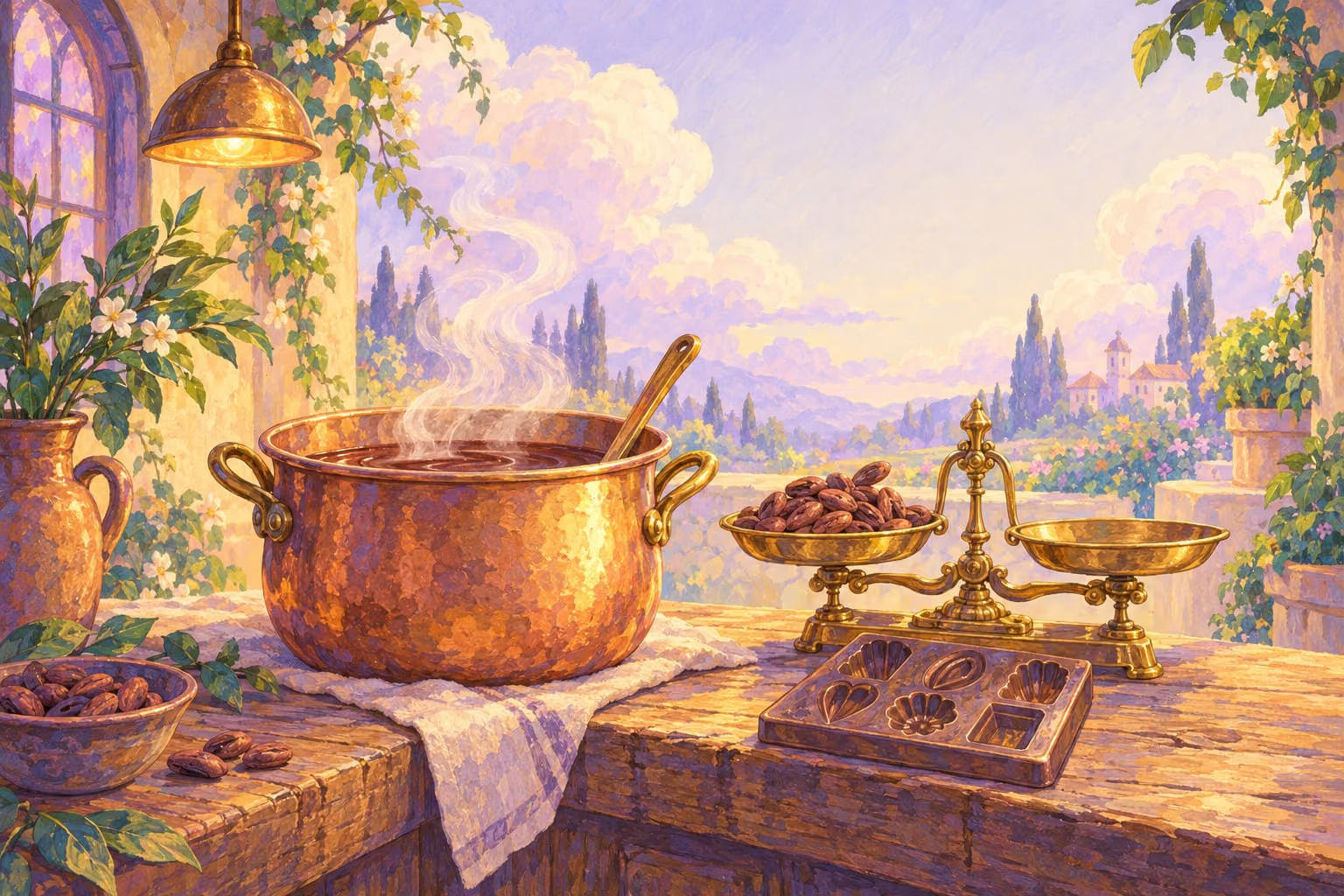
How this church makes the chocolate
A sacrament is a batch with a number on it. Where the cacao comes from, how the mushroom is ground, what the lab checks twice, and why we dose by the piece.
People write to us as if the chocolate arrives from a cloud. It arrives from a kitchen, from a scale, from a lab report, and from a lot of waiting. This essay is the whole process, from the tree to the wrapper, told in enough detail that you could catch us if we ever cut a corner. We are a church, and we are also people who weigh, temper, pour, test, and wrap. Those two facts share a room.
One rule before the kitchen: the work is for adults twenty-one and over, and the sacrament goes to members. Everything below assumes a grown person who has read the dosage guide and wants to know how a bar is actually born, not how it is marketed.
What we mean by sacrament
A sacrament, here, is something taken with intention, in a dose we can name, in a form you can hold. Chocolate is a carrier with a history older than our congregation; people were drinking cacao in ceremony long before anyone thought to sell a bar. Gummies are a carrier that adults actually finish, which matters more than it sounds, because a half-eaten sacrament is a dose you cannot name afterward.
We do not call the bar a cure and we do not call the gummy a clinical product. A sacrament is not a treatment. It is a practice, and a practice is only as honest as the person doing it. Our part of the honesty is the batch: what went in, how much, and what the lab found. Your part is the room you take it in, which the safety essay covers.
Where the ingredients come from
Start with the cacao, because the cacao is the bar. Ours is wild-harvested in the Andes, from trees growing in the jungle rather than rows on a plantation. The trees average around seventy years old. Old trees on wild ground give a deeper bean, and, just as important to us, this source tests clean for the heavy metals that show up in a lot of commercial chocolate. No cadmium. No lead. We chose it for both reasons and we will keep choosing it as long as the tests stay clean.
The cacao butter comes from the same source. The sugar is organic. That is the entire bar apart from the mushroom and the flavor: cacao, cacao butter, sugar, mushroom, and whatever gives a rose bar its rose. No nuts, no dairy. A person with a nut allergy can read that sentence and relax.
The mushrooms come from a handful of cultivators we work with directly, growing specific strains for our offerings. We use fruiting body, not mycelium grown on grain, because fruiting body is the part of the organism that carries what we are here for. It is dehydrated and then ground to twenty microns on a stone grinder at our facility, which operates under current good manufacturing practice. Twenty microns is finer than flour. At that size the mushroom disappears into the chocolate instead of sitting in it as grit, and, more to the point, it distributes evenly, so one square is the same as the next.
The first test
Before any mushroom goes near the kettle, the batch is tested for potency. This is the step that makes dosing by the piece possible. If we did not know the strength of the ground mushroom, we could not say what a square carries, and a sacrament whose dose is a guess is not a sacrament we would put our name on.
The test comes back as a number, and the number sets the recipe for that batch: how much mushroom per kilogram of chocolate so that each square lands where the dosage guide says it lands. Different harvests differ. The recipe moves to keep the square steady. That is why we say every batch is its own thing, with its own number, and why we would rather adjust a recipe than pretend two harvests were identical.
The night of a batch
A batch starts with a list, not a mood. Weight of cacao and butter. Weight of sugar. Weight of mushroom, set by the potency result. The temperature of the room, because chocolate cares about the room. Who is in the kitchen. It is written down before anything melts, and it is written down because memory is a bad ledger when the kettle is hot.
Tempering is the unglamorous part. Cacao butter can set into several crystal forms, and only one of them gives a bar that snaps, shines, and melts the way chocolate should. Tempering is heating and cooling the chocolate through a precise range so that the right crystals form and the wrong ones do not. Rushed chocolate blooms: a dull, streaky haze on the surface. Bloom is not dangerous. It is a confession that someone got impatient. We would rather wait than ship a bar that looks like it has a fever.
The mushroom goes in with the flavor once the chocolate is in temper, mixed until it is even, then poured into molds and left alone. The room has to be still enough that a draft does not throw the set. When the bars release clean from the mold with a snap, they are ready for the second test.
Gummies follow their own clock on the same bench. Pectin sets on its own schedule, the mushroom is blended in at the same twenty-micron grind, and each gummy is one serving. Watermelon, passionfruit, pineapple, black cherry, eight to a pack. We make the gummy because some adults will not finish a bar, and finishing matters.
The second test
The finished bar goes to an independent domestic lab, and the lab checks three things: potency, so the dose on the guide is the dose in the square; impurities, so nothing arrived in the chocolate that should not be there; and alkaloids, the profile of what the mushroom actually contains. The result is a certificate of analysis for that batch.
The batch number printed on the wrapper corresponds to that certificate. It is the most important thing on the foil, more than the flavor and more than the name. Ask for the certificate by batch number and we will send it. We publish this system not because a regulator required it but because we think a stranger with a chromatograph is a better witness than a brand with a story.
Testing before and after is how we can say two things at once: this is a ceremonial product made by a church, and this is a measured product you can count. Most of the market chooses one of those sentences. We were not willing to.
The four bars
Rose, mint, lavender, and the mystery bar. The flavors are not decoration. Rose and lavender are there because a floral note sits well with the earthiness of the mushroom and with the way a night tends to soften; mint is there for the people who want the chocolate to taste awake. The mystery bar rotates through flavors we are still testing, and it says so on the wrapper. It is our way of trying something new without pretending the trial is a tradition.
Whatever the flavor, the mushroom content per square is set by the same potency test and the same recipe math. Rose does not carry more than mint. A square is a square across the four bars, which is the only way a framework written in pieces can be trusted.
Why we dose by the piece
A bar is scored into squares and each square is one serving. A gummy is one serving. We do not ask you to read milligrams off a wrapper in a candlelit room, and we do not ask you to break a piece in half and hope. The Walk, Run, Fly framework on the dosage guide is written in pieces for that reason: one to three, four to seven, eight to ten.
The piece is also how a night stays honest between two people. If you share a bar, say how many squares you each took. Two people with two counts have two nights and one truth. Two people with a guess have one lie neither of them meant to tell.
Small batch means the recipe is allowed to move. A harvest tests stronger, the mushroom per kilogram goes down; a harvest tests softer, it goes up; the square stays where the guide says it is. A factory would fix the recipe and let the dose drift. We fix the dose and let the recipe drift, and we write the recipe down each time so the drift is a record and not a rumor.
Start low. You can take another square later. You cannot take one back.
What we will not print on the wrapper
We will not print that the bar is legal wherever you carry it. Law is local and it changes at county lines; we ship only where our sacraments are permitted and we ask you to know your own ground. We will not print that a paper from 2006 or a book from 1984 blesses our recipe; those belong to their authors, who taught us to be careful and did not write our kitchen list. We will not print a testimonial, because a testimonial is a story about someone else's night and your night is yours.
What the wrapper will always carry is a batch number, a piece count, the ingredients, and the age line. If we cannot fit those, we have a design problem, and design problems get solved with smaller type, never with a smaller truth.
After the wrapper
Your order leaves in plain outer packaging, with nothing to say who sent it or what is inside, within two or three business days, with tracking by email. If it arrives damaged or wrong, write within fourteen days with the order number and a photo, and we will replace it, credit it, or refund it. Opened sacraments cannot come back, for the reason a bakery cannot take back a bitten loaf.
Keep the bar cool and dry, out of sunlight, and out of reach of children; a sacrament in a kitchen drawer is a hazard, and a sacrament on a high shelf in its wrapper is a batch you can still identify a month later. Keep the wrapper until the bar is gone. The batch number is on it, and the batch number is the only thing that connects the square in your hand to the certificate that describes it.
Hold a square before you eat it. Feel whether it snaps. A snap means the crystals agreed with each other, which means the tempering was done right. Read the batch number out loud once; it makes the number real. Then sit down. Standing while you eat is how people treat this like a party favor, and a party favor does not get a journal.
How to visit without turning us into a myth
Come to the shop as if you were buying bread from a neighbor who takes bread seriously. Ask what is in this batch, when it was made, and what the lab found. If the answer is a date, a list, and a document, you have found us. If the answer is a story about clouds, walk out. We would.
If you never buy, you can still read. The Journal is the public table, not a funnel with better lighting. The rest is conversation, and the address for that is sanctuary@mail.herochurch.org. Ask about a batch, ask for a certificate, ask why rose. We answer with the list, not a slogan.
QUESTIONS PEOPLE ASK
- What is in Hero Church chocolate?
- Wild-harvested Andean cacao and cacao butter, organic sugar, fruiting-body mushrooms ground to twenty microns, and the flavor of the bar. No nuts, no dairy, vegan.
- How is each batch tested?
- The ground mushroom is tested for potency before it goes into the chocolate, and the finished bar is tested again by an independent domestic lab for potency, impurities, and alkaloids. The batch number on the wrapper corresponds to that certificate of analysis, available on request.
- What does one piece contain?
- One measured serving. Every square of a bar and every gummy is dosed as a single piece, and the dosage guide counts in pieces: one to three for a walk, four to seven for a run, eight to ten for a flight.
Continue reading
Healing
What a psychiatrist can and cannot promise
People search for mushrooms and depression at one in the morning. Here is what the clinic owns, what the published trials actually show, and where a church stops.

Culture
Musicians who said the mushroom out loud
Margo Price took a bag of mushrooms to a rental house and came back with Strays. What a church journal can learn from musicians who said the word in public, and what it refuses to borrow from them.
Safety
Set, setting, age, and what we will not claim
Safety is not a waiver dressed as an essay. It is a short list of rooms we will not enter, a longer list for your fridge, and the claims you will never find on our wrapper.